How the Transfer Portal Changed the Game for Many OC Riptide Players in 2024
In an age where athletes possess the ultimate freedom to change schools, thousands of players utilize the transfer portal each year to set themselves up on the best pathway for success in their careers. This summer, a handful of Riptide players took advantage of the abundance of opportunities the portal presents and found new homes for the upcoming spring season.
As the head coach of the Riptide, Connor Spencer spent the season helping some of his players navigate through the transfer portal process and advised players on how to deal with the pressure it brings.
“At the end of the day what it boils down to is what your goals are as a player,” Spencer said. “Whether it’s to play professionally, get playing time, win championships… there are so many factors that players have to weigh. My biggest advice to the guys is to keep your nose to the grindstone and control what you can control with your attitude, emotions and the day-to-day grind of being in a professional baseball environment.”
Due to players coming from different circumstances and being at varying points in their careers, the transfer portal experience varied for the many Riptide players that entered it this summer.

Mississippi State commit Ace Reese lived up to the hype for the Riptide this summer, as he led the team in batting average hitting .369.
(Photo courtesy Dingers Photography)
Houston to Starkville
As one of the more high-profile players in the portal this summer, Ace Reese garnered an immense amount of attention from coaches and scouts who hoped to draw the University of Houston transfer to their respective schools.
In fact, Reese missed a few games in the middle of the Riptide season due to him taking official visits to SEC schools such as Texas A&M University and Mississippi State University.
“I was really busy,” Reese said. “I was on the phone all day talking with schools throughout the process.”
Nevertheless, Reese set his priorities straight early into the process and ultimately landed on Mississippi State due to the connection he built with the coaching staff.
“I was looking for the schools that wanted me the most,” Reese said. “I went to Mississippi State and had an awesome experience because it felt like they really wanted me.”
Knoxville to Tempe
Similar to Reese, Riptide infielder Camden Bates (Arizona State University) made his decision to transfer to ASU primarily based on conversations with the Sun Devil’s coaching staff. In these discussions, Bates developed a sense of trust with the ASU coaches, allowing him to feel confident in his development path going forward with the Sun Devils.
“It was really just the coaching staff, their culture over there is awesome,” Bates said. “The coaches truly care about their players and that was something that attracted me to them. Being able to get to know the coaches more and develop relationships was really important.”
San Jose to Ann Arbor
For Riptide catcher Matt Spear (University of Michigan), making his decision to transfer to Michigan early in the summer allowed him to focus on developing and negated any negative effects of being in the portal during his summer ball experience.

Michigan commit Matt Spear proved to be an important piece for the Riptide, as the catcher maintained a .326 batting average in the regular season and provided solid defense behind the plate for OC.
(Photo courtesy Dingers Photography).
“Coming into summer ball and already knowing where I’m going to go to school is something that I’m thankful for,” Spear said. “I think coming out here and not having to impress everyone that’s coming to watch and not having to worry about where I’m going is good for my development as a baseball player.”
Berkeley to Long Beach
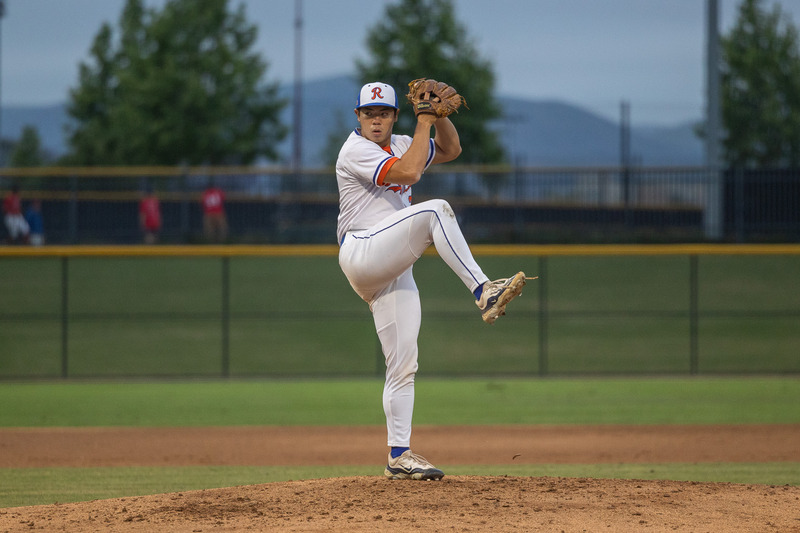
Pitcher Arthur Liu (Long Beach State University) capitalized on his opportunity with the Riptide by putting together impressive performances in front of Division 1 coaches to garner interest from multiple schools.
“I think it was a great opportunity,” Liu said. “A lot of the local Division 1 schools came out to watch me pitch first-hand. It was a great way for me to get time to talk with coaches and for them to see me perform on the field.”
With a limited time frame to make an impression, players may feel pressure to stand out in each outing. Nonetheless, Liu blocked out the noise and maintained a steady head to shine in his outings with Riptide, as he provided a consistent arm in the OC bullpen.
“There was obviously some pressure with not knowing which school I would end up at,” Liu said. “But I don’t think I viewed it any differently than any other games I’ve played. I just had something I was working towards being in the portal.”
Finally, with more freedom comes a greater responsibility on these makeshift “free agents” to maintain a consistent routine throughout the summer.
Spencer reiterated the theme of maintaining a professional mindset throughout the summer and made it his mission to instill traits of consistency in his players before the end of the summer.
“The guys in the portal have no one to hold them accountable,” Spencer said. “Back when I played, the only thing that kept me from leaving during the summer was my head coach at my college telling me I still needed more at-bats and needed to keep working. For a lot of these portal guys, that doesn’t exist.”
With the NCAA making massive changes such as expanding the amount of scholarships available to teams from 11.7 to 34 while decreasing roster sizes from 40 to 34 players, the future of college baseball stands littered with uncertainty.
Still, many collegiate coaches, including Spencer, remain confident that the transfer portal ultimately serves for the betterment of the players, which should remain the focus for decision-makers, as college baseball continues to evolve.
“All of these decisions being made are all good things in the long run for college baseball and all made for the betterment of the game,” Spencer said. “At the end of the day obviously there’s positives and there’s negatives but I feel that the positives outweigh the negatives.”